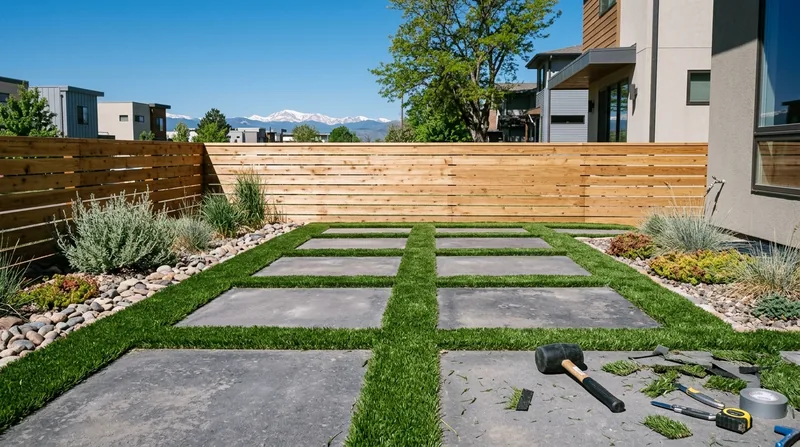




Denver's mix of Victorian brick homes in Capitol Hill, 1920s bungalows in Washington Park, Tudor estates on Park Hill's tree-lined streets, and modern infill across Highland and Sloan's Lake creates a patchwork of outdoor living spaces, many of them small, hard to access, or in direct high-altitude sun. Patios, balconies, and the narrow turf strips between pavers on rooftops and side yards face intense UV exposure at 5,280 feet, freeze-thaw cycles that crack concrete, and the challenge of drainage on surfaces that shed water rather than absorb it. Patio, balcony and turf-paver strips in Denver demand an artificial grass installation approach built specifically for hard surfaces: a resilient turf product, a draining underlay system that prevents standing water and ice, and edging that holds under Denver's seasonal movement. We install turf on concrete, composite decking, and existing pavers, turning unusable outdoor space into low-maintenance living areas that don't fade, don't require irrigation, and perform through Colorado's unpredictable weather. For residential yards, also see our residential artificial grass installation service.
Why Patios, Balconies, and Turf-Paver Strips Matter in Denver's High-Altitude Climate
Real grass will not grow on concrete or composite decking, and the few plants that tolerate Denver's intense afternoon sun and thin air on an exposed balcony or rooftop typically wither by mid-July. The challenge is not just heat but also the freeze-thaw cycle: water trapped beneath a patio or between pavers expands when it freezes, lifting and cracking concrete, and creating gaps where weeds and moss take hold. Artificial turf solves both problems at once. A properly installed turf system on a hard surface includes a perforated underlay that allows water to drain through to the base, preventing ice buildup and the structural damage that follows. The turf itself stays cool, green, and inviting year-round, even in Denver's intense high-altitude sun.
- Turf on concrete and composite decking drains water away from the surface, eliminating standing puddles and ice hazards.
- Denver's UV intensity at 5,280 feet fades real grass but not UV-stabilized synthetic turf rated for high-altitude exposure.
- Balcony and rooftop turf creates usable outdoor living space without the weight, cost, and maintenance of planters and soil.
- Turf-paver strips between flagstone or permeable pavers soften hardscape while maintaining the structure and drainage of the paver system.
- The installation is permanent and does not require seasonal teardown or replanting after Denver's heavy snow or freeze-thaw cycles.
These surfaces take the most punishment in Denver's climate, so the right turf product and underlay system make the difference between a three-year failure and a fifteen-year installation.
Key info: Denver's winter freeze-thaw cycle is the leading cause of concrete spalling and paver settlement. A draining underlay system beneath turf on hard surfaces prevents water from pooling and freezing, protecting the concrete or decking underneath from structural damage that can cost thousands to repair.
For more on how Colorado winters stress outdoor surfaces, see the City and County of Denver outdoor space maintenance resources.
How We Install Artificial Turf on Patios, Balconies, and Paver Strips in Denver
Installation on hard surfaces is not the same as laying turf in a yard. The concrete or composite decking must be inspected for cracks, uneven spots, and existing drainage issues. We assess the slope and existing water flow, then lay a perforated underlay that channels water to the edges or to drain points. The turf is glued down with a turf-specific adhesive that holds through Denver's temperature swings, from 90 degrees in summer to below zero in winter. Seams are sealed with a UV-stable seam tape that prevents water from wicking beneath the turf. Edging is secured with aluminum or composite trim that locks the turf in place and creates a finished look. The result is a seamless, low-maintenance surface that handles foot traffic, snow load, and the intense Colorado sun.
- We inspect the concrete or composite surface for cracks, settlement, and existing drainage patterns.
- We clean the surface thoroughly to remove dirt, algae, and any loose material that would prevent adhesive bond.
- We lay a perforated underlay that allows water to drain through while providing a smooth, cushioned base for the turf.
- We measure and cut the turf to fit the exact dimensions of the patio, balcony, or paver strip, accounting for slope and obstacles.
- We glue the turf down with turf-specific adhesive, working from one end to the other to avoid wrinkles and air pockets.
- We seal all seams with UV-stable seam tape and seal the edges with aluminum or composite trim.
- We brush the turf to stand the pile upright and ensure a uniform appearance across the entire surface.
From start to finish, the process takes one to three days depending on the size of the area and the complexity of the surface underneath. A typical patio in Englewood, Littleton, or Denver itself is finished in one day.
Local example: A 300-square-foot balcony on a Capitol Hill brownstone with cracked concrete and poor drainage took us two days to prepare, install underlay, and finish. The turf now sheds water, handles foot traffic, and requires only a rinse twice a year to stay clean. No staining, no algae, no ice hazard in winter.
For related work on residential yards, see our pool surround turf installation service, which uses the same drainage-first approach.
Installation Methods and Approaches for Hard Surfaces
| Approach | Description | Best for |
|---|---|---|
| Glue-down on concrete with perforated underlay | Turf is adhered directly to clean, dry concrete with turf-specific glue and a perforated foam or rubber underlay beneath it to allow drainage and provide cushioning. | Patios, balconies, rooftops, and any hard surface where the base is stable and water must drain away from the structure. |
| Turf-paver strips with permeable base | Turf is installed between existing pavers or flagstone, glued to the concrete base and sealed at the edges to prevent water from pooling in the joints. | Side yards, patios with mixed paver and turf design, and rooftop gardens where the paver system is already in place. |
| Composite decking installation with underlayment | Turf is glued to composite deck boards with a protective underlayment that prevents moisture from seeping into the deck structure and extends the life of the decking. | Balconies and rooftops with composite or wood decking where the deck itself must be protected from water damage. |
| Concrete repair and turf overlay | Cracked or spalling concrete is patched and sealed before turf is installed, ensuring a stable, level base that will not settle or shift under foot traffic. | Older patios in Denver, Greenwood Village, and Cherry Hills Village where the concrete has shifted or deteriorated from freeze-thaw cycles. |
Each method is chosen based on the condition of the existing surface, the slope and drainage pattern, and the long-term durability required for Denver's climate. We name the underlay product, the turf face weight and pile height, and the adhesive type in writing so you know exactly what you are getting.
Patio, Balcony and Turf-Paver Strips Cost in Denver: What to Expect
Pricing for artificial turf installation on hard surfaces in Denver starts at $9 per square foot for a straightforward patio or balcony with good existing drainage and a clean, level concrete base. The cost rises if the concrete is cracked or uneven (requiring prep and leveling), if the surface has poor drainage (requiring more extensive underlay work), or if the job is on a balcony or rooftop that requires careful access and safety measures. A 300-square-foot patio typically runs $2,700 to $3,600 installed, depending on the turf product selected and the condition of the base. A 600-square-foot balcony or rooftop system with reinforced underlayment and sealed edges runs $5,400 to $7,200. Turf-paver strips between existing flagstone are priced by the linear foot or by the square footage of turf, typically $12 to $16 per square foot because of the precision required in cutting and sealing around the pavers.
The biggest cost drivers are the condition of the existing concrete or decking, the complexity of drainage, and the turf product itself. We always give you the square footage, the turf specs (face weight, pile height, infill type), the underlay type and thickness, and the labor estimate in writing before we start. Travel is included in Denver and surrounding areas. For a full pricing overview and examples for other services, see our pricing page.
Get 2 to 3 estimates from different turf installers so you can compare not just price but also the quality of the turf product, the underlay system, and the warranty on the work. The cheapest estimate is often the one using the thinnest turf and the skimpiest underlay, which fail in Denver's freeze-thaw cycle within two to three years.
Patio, Balcony and Turf-Paver Strips Near Me: What Denver Homeowners Should Know When Hiring
When you call a turf installer for a patio or balcony job, ask for three things upfront: a certificate of insurance naming general liability and workers' compensation, a written specification of the turf product (brand, face weight, pile height, infill type and pounds per square foot, underlay type and thickness, and adhesive), and photos of similar work on hard surfaces. These three items tell you whether the installer knows the difference between a residential yard installation and a hard-surface job, which is critical for Denver's climate. Ask how they handle drainage on the specific surface you have (concrete, composite, or pavers) and what they do if the concrete is cracked or uneven. A good installer will never glue turf to a cracked or settling patio without first assessing and repairing the damage underneath. Ask about the underlay product by name and why they chose it for your application. If they say underlay is optional or that they can glue turf directly to concrete, that is a red flag: without an underlay, water pools beneath the turf, freezes in winter, and lifts the turf or damages the concrete.
- Request a certificate of insurance showing general liability and workers' compensation coverage before signing any agreement.
- Insist on a written specification naming the turf product, face weight, pile height, infill type and rate, underlay product and thickness, and adhesive type.
- Ask for references and photos of similar work on patios, balconies, or rooftops, not just yard installations.
- Clarify who handles any necessary concrete repair or leveling and whether that cost is included in the estimate or quoted separately.
- Confirm the warranty on the installation work itself (typically one to three years on seams and adhesive) and understand that manufacturer warranties are separate and limited.
- Ask whether the installer has experience with Denver's freeze-thaw cycle and how they design the drainage system to handle winter water and ice.
Hiring a local, independent turf installer who names the product and the specs in writing protects you from cut-rate work that fails in two years. For a free estimate and to discuss your specific patio, balcony, or paver strip project, contact us at (720) 734-4925. We respond within 24 hours, and the estimate is free and no-obligation.
Patio, Balcony & Turf-Paver Strips in Denver: Pricing Guide
| Service | Price | Details |
|---|---|---|
| Patio or balcony turf installation | Starting at $9/sq ft | Clean, level concrete base with good existing drainage, standard underlay, glue-down installation with sealed edges |
| Turf-paver strips between flagstone | Starting at $12/sq ft | Precision cutting and sealing around existing pavers, perforated underlay, glued installation with sealed joints to prevent water pooling |
| Rooftop or composite deck turf | Starting at $14/sq ft | Reinforced underlayment to protect the deck structure, sealed edges, adhesive rated for temperature swings and UV exposure at high altitude |
| Concrete repair plus turf installation | On estimate | Required when existing concrete is cracked, spalling, or uneven from freeze-thaw cycles or age; repair cost depends on damage extent |
| Travel and estimate | Included and free | No mileage fee or travel surcharge in Denver and surrounding areas; free estimate with response within 24 hours |
Indicative pricing, the exact cost depends on square footage, finish, and site access. Free personalized estimate within 24h at (720) 734-4925.


