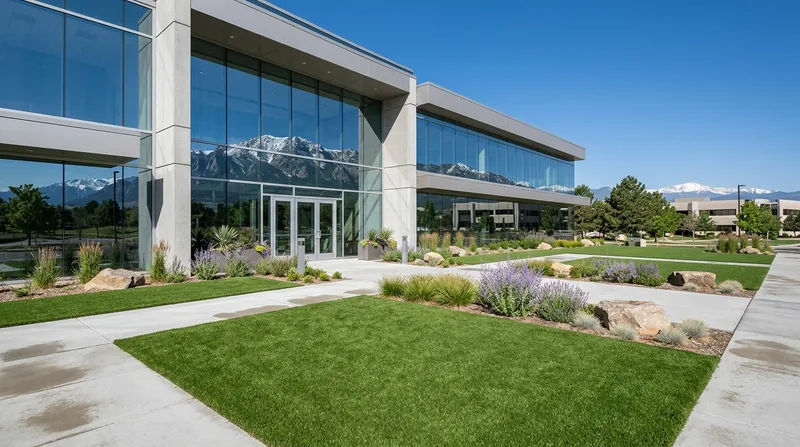




Commercial Artificial Grass Installation in Denver transforms retail frontages, office campuses, HOA common areas, dog parks and multi-family properties across the high plains and foothills with turf that handles foot traffic, weather swings and maintenance demands that real grass cannot sustain. Denver's intense high-altitude sun, freeze-thaw winters, summer hail and clay soil make artificial turf a practical choice for commercial landscapes where downtime and brown patches cost money. We install turf on retail properties in Cherry Creek and LoDo, office parks in Tech Center, HOA grounds in master-planned communities like Central Park and Lone Tree, and municipal dog parks across the metro. Since 2013, we have named the product, face weight, pile height and infill in writing on every commercial job, because property managers and HOA boards need specifications they can hold us to. A free commercial estimate gets you a site visit, a written spec and a realistic timeline before you commit.
Why Commercial Artificial Grass Installation Matters in Denver
Commercial properties in Denver face a unique set of pressures. Real grass in high-traffic zones wears thin by mid-season, clay soil stays wet after spring snowmelt and afternoon storms, and the 300 days of annual sunshine bleach out dormant turf in winter and cook it in summer. Artificial turf eliminates brown patches that hurt curb appeal, reduces water bills on properties that cannot afford seasonal irrigation, and handles the freeze-thaw cycle without heaving or bare spots. Property managers in Greenwood Village, Littleton and Golden report that turf cuts maintenance costs and liability by removing mowing, fertilizer applications and uneven surfaces that create trip hazards.
- Artificial turf tolerates high foot traffic and vehicle parking without compaction or ruts, keeping commercial landscapes presentable year-round.
- Denver's alkaline clay soil and variable moisture mean real grass requires constant amendment and drainage work; turf sidesteps those costs.
- HOA communities and retail properties save water and eliminate the seasonal brown-out that occurs when real turf goes dormant in winter or heat-stressed in summer.
- Turf reduces liability from uneven ground, trip hazards and muddy drainage patterns that develop on worn real grass.
These factors make turf installation a strategic investment for any commercial property in the Denver metro.
Key info: Denver's HOA architectural review boards commonly govern appearance standards for common areas, including turf color, pile height and edging. We help prepare HOA submittals and coordinate with your board, but approval rests with your community. Check your CC&Rs before requesting an estimate.
For detailed guidance on regulations and permitting, refer to Denver's Development Services portal, which covers grading and drainage work that may accompany turf installation on commercial sites.
How We Install Commercial Artificial Grass in Denver: Our Process
Commercial projects demand precision in base preparation, seaming and drainage because the property is in constant use and failure is visible to customers, tenants and board members. We start with a free site visit to assess foot traffic patterns, existing drainage, utility lines and any structural constraints. We then prepare a written spec naming the turf product, face weight in ounces per square yard, pile height, infill type and pounds per square foot, and base depth and compaction. This spec becomes your guarantee and your proof of what was installed.
- We request a Colorado 811 utility locate to identify buried electric, gas and water lines before any excavation begins.
- We remove existing turf or pavement, grade the site to proper slope for drainage and compact the base to remove soft spots that cause settling.
- We install a sub-base layer (typically 4 to 6 inches of compacted gravel or recycled asphalt) to ensure water drains away from buildings and pooling does not occur.
- We lay a geotextile membrane to prevent base materials from migrating into the turf and infill.
- We unroll and seam the turf using hot-melt adhesive, ensuring seams are tight and invisible and pile direction is consistent across the entire surface.
- We infill the turf with the specified material (typically silica sand, crumb rubber or recycled polyethylene) and brush it into the pile.
- We perform a final walkover to confirm pile height, infill distribution and seam integrity before we sign off.
This methodical approach prevents the common failures seen on commercial sites: seams that separate under foot traffic, infill that migrates into parking areas, and base settling that creates low spots and puddles.
Real example: A retail property in Cherry Creek had a 2,000-square-foot entry courtyard with a slope toward the building that caused water to pool after spring snowmelt. We cut a swale into the base, installed 6 inches of compacted gravel with positive drainage toward the street, laid a geotextile and finished with a 55-ounce turf and silica sand infill. The property now drains cleanly and the turf has held for three seasons without settling or seam separation.
Learn more about our residential artificial grass installation process, which follows the same rigorous base prep and seaming standards we apply to commercial work.
Commercial Turf Installation Methods: Choosing the Right Approach for Your Property
| Installation Method | Description | Best For |
|---|---|---|
| Full base replacement | Remove existing turf or hardscape, excavate and compact a new base with proper drainage slope and geotextile underlayment. | Properties with poor drainage, uneven settling or existing turf that has failed. |
| Overlay on existing base | Clean and level an existing compacted base, add a geotextile and lay new turf if the existing base is sound and drains well. | Properties with solid drainage and no settling issues, where excavation cost must be minimized. |
| Perimeter edging and transition | Install aluminum or composite edging to define turf boundaries, prevent infill migration and create a finished appearance at walkways and pavement. | Any commercial installation where turf meets hardscape or a different surface. |
| Turf-paver strips and parking lot edges | Install turf in narrow strips between concrete pavers or along parking lot edges to soften hardscape and manage stormwater runoff. | Office parks, retail courtyards and multi-family properties where green space must be integrated into paved areas. |
| Slope and drainage correction | Grade the base to direct water away from buildings and low spots, install French drains or catch basins if needed before laying turf. | Properties with existing water problems, clay soil or areas where winter snowmelt or spring storms cause pooling. |
The right method depends on your existing base condition, drainage patterns and budget. We assess all of these during the free estimate and recommend the approach that prevents future problems.
Commercial Artificial Grass Installation Cost in Denver: What to Expect
The cost of commercial artificial grass installation in Denver ranges from $3 to $8 per square foot installed, depending on base condition, site access, turf product selection and drainage complexity. A 2,000-square-foot courtyard with a sound existing base and good drainage might run $6,000 to $16,000 installed. A 5,000-square-foot dog park or HOA common area with poor drainage and full base replacement could reach $25,000 to $40,000. These figures include the turf, base prep, infill and labor, but not hardscape work like concrete removal or paver installation, which are separate scopes.
Several factors move the price up or down. A property with existing compacted base and good drainage costs less than one requiring full excavation and French drain installation. High-traffic areas need a heavier turf (60 to 70 ounces per square yard) than low-traffic zones (40 to 50 ounces), and premium products or specialized infills like antimicrobial zeolite add cost. Site access matters: a ground-level courtyard is faster than a rooftop or a narrow alley, and utility line conflicts can require rerouting or careful hand-digging that increases labor.
We start every commercial project with a free estimate. Call (720) 734-4925 to schedule a site visit; we respond within 24 hours and provide a written spec and price breakdown before you commit. For a detailed look at our pricing across all services, visit our pricing page.
What to Look for When Hiring a Turf Installation Company Near Denver
The Denver metro is home to turf installers ranging from established local companies to crews that travel from job to job laying turf over bare dirt. Choosing the right installer protects your investment and prevents costly repairs down the road. A reputable turf installation company will provide a certificate of insurance naming general liability and workers' compensation coverage, a written spec that names the turf product, face weight, pile height, infill and base depth, and references with photos of finished commercial work you can inspect. Ask how long they have been in business, whether they handle their own seaming or subcontract it, and what warranty they offer on their workmanship (typically one to three years on the installation).
Verify that the installer understands Denver permitting and HOA requirements. If your property is in an HOA, the installer should help you prepare an architectural review submittal with product samples and site photos, though approval rests with your board. For commercial projects involving grading that changes drainage, confirm that the installer will coordinate with the city or county building department and pull permits if required. Ask whether they request a Colorado 811 utility locate before excavation; this protects against hitting buried lines and is standard practice on any commercial job.
Get at least two or three estimates and compare the written specs, not just the price. A low bid that omits base preparation or uses a thin turf product will fail within a season. References matter: call an HOA manager or property manager who has used the installer and ask whether the turf has held up, whether seams are tight and whether drainage works as promised. For a free estimate and a chance to discuss your project in detail, contact us at (720) 734-4925.
Commercial Artificial Grass Installation in Denver: Pricing Guide
| Service | Price | Details |
|---|---|---|
| Free commercial estimate and site assessment | Free | Site visit, written spec with turf product and base details, price range and timeline within 24 hours |
| Commercial turf installation, typical property | Starting at $3 to $8 per sq ft | Varies by base condition, site access, turf weight, infill type and drainage complexity; measured on site |
| Small commercial project, 500 to 2,000 sq ft | $1,500 to $16,000 | Entry courtyard, small dog park or HOA common area with standard base prep and infill |
| Large commercial project, 5,000 sq ft or more | On estimate | Multi-tenant property, office park or municipal site; requires site visit to assess drainage and base condition |
| Travel and mobilization | Included | No separate mileage fee or travel charge for Denver and surrounding service areas |
Indicative pricing, the exact cost depends on square footage, finish, and site access. Free personalized estimate within 24h at (720) 734-4925.


